 Owlio
MATIC or POL? Check which Polygon balance your wallet shows
A MATIC label can mean an old network setting or a separate Ethereum token. Identify the balance before treating it as an unfinished migration.
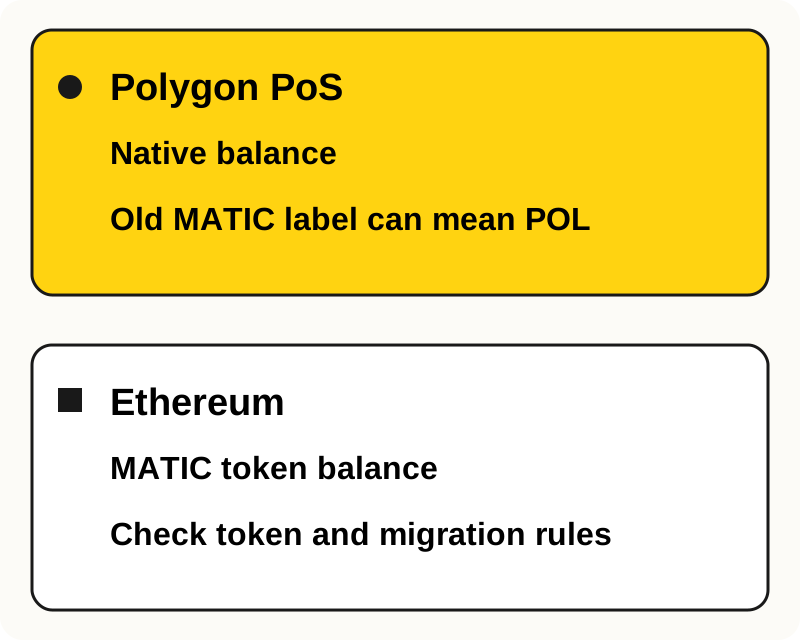
A wallet that still says MATIC has not necessarily missed the POL upgrade. Polygon PoS changed its native gas token to POL on 4 September 2024. That native balance upgraded automatically, while an older wallet setting can keep displaying the MATIC name. MATIC held as an ERC-20 token on Ethereum is a different case. Identify the network and the kind of balance before deciding what the label means.
The Polygon launch announcement records the network change. This guide checks the distinction using official documentation available on 9 November 2026. It covers identifying a holding, not submitting a migration transaction.
Start with the network and the balance row
Open the account you meant to inspect and note its network. Then determine whether the row is the network’s native coin, an ERC-20 token, or a position inside another service. A familiar logo and the letters MATIC are not enough to distinguish these cases.
| Where the holding is | What to check | What the name tells you |
|---|---|---|
| Polygon PoS native balance | Account, network, native coin amount | An old MATIC label can still refer to POL |
| Ethereum wallet, MATIC token | Full token contract and account balance | This is the Ethereum token, not Polygon’s native coin |
| Polygon staking on Ethereum | The staking position | Separate from idle wallet MATIC |
| Exchange or DeFi service | Its asset record and current guidance | Its own accounting must be checked |
For an ERC-20 row, compare the complete contract address with the project’s official record on the same network. The wallet address versus token contract guide explains which address identifies the holder and which identifies the asset. Do not send funds to a token contract to make it appear in a wallet.
On Polygon PoS, an old label can be the whole problem
Polygon Support explains that the native balance converted at a 1:1 ratio without a manual migration. It also describes the stale currency-symbol setting that can leave MATIC on screen.
Compare the wallet’s native amount with the same account on a Polygon PoS explorer. Use matching observation times where possible, since transactions can change the amount. If the network, account and balance match, a different ticker alone does not show missing funds.
If the remaining issue is the label, follow your wallet’s instructions for its native currency symbol. Renaming that setting changes a display label. It does not send coins, bridge them, or convert an Ethereum token. There is no need to approve a contract merely to rename the native currency.
For example, imagine two views of the same native holding, with no intervening balance change: one says 100 MATIC and the other 100 POL. These are alternative labels for that holding, not evidence that the account owns 200 tokens. This is an illustrative example, not a wallet measurement.
Ethereum MATIC needs a different check
An idle MATIC ERC-20 balance on Ethereum did not automatically convert to POL when Polygon PoS changed its gas token. The Polygon migration guide describes a separate Ethereum migration mechanism. Its staker and delegator exception matters: do not treat a staking position as idle wallet tokens.
Check the token identity first. Polygon publishes the Ethereum POL contract in its official contract reference. Adding that token to a wallet’s display does not convert a MATIC balance. A token name typed into a custom-token form is not evidence of migration either.
The POL documentation describes a one-for-one token conversion. That ratio is not a market-price guarantee. If a migration is relevant, consult the current official guide for the transaction itself. Do not apply the Polygon PoS label fix to Ethereum, Polygon zkEVM, an exchange balance or a DeFi position.
How to read this distinction in Owlio
The source associated with Owlio 1.1.0, the version listed in the Chrome Web Store on 9 November 2026, names Polygon’s native asset POL and records Ethereum MATIC as a separate asset. This is a check of the release-associated code, not a test of a particular installed wallet or a promise that every POL representation is covered.
Expand an asset to see its contributing networks and shortened wallet addresses. A combined row is a starting point for reconciliation, not proof that migration took place. Wrapped holdings also need their own identification; the ETH and WETH explanation shows why a native coin and a token representation can require different checks.
Keep a short note with the network, account, native-or-token distinction, contract where applicable, amount and observation time. The useful result is knowing which holding each screen describes. Only then can the official instructions for that case answer whether any migration action remains.
Frequently asked questions
Does changing the wallet symbol from MATIC to POL move tokens?
No. Editing the native currency label changes how the network balance is named in that wallet. It does not migrate an Ethereum ERC-20 token or transfer funds between networks.
Does the 1:1 migration mean MATIC and POL always have the same price?
No. The migration ratio describes token quantities in that mechanism. It does not promise equal market prices, a dollar value, or a fee-free transaction.
Do Polygon stakers on Ethereum need the same migration as wallet MATIC holders?
Polygon's migration documentation says MATIC stakers and delegators do not need to take action to migrate. A stake in that system is different from an idle ERC-20 balance in a wallet; check the relevant staking position.