 Owlio
Solana wallet, token account or mint: identify the address
A token account's address, its mint and its owner serve different purposes. Use a field map to identify the record you are inspecting on Solana.
A Solana token account records an amount of one token for a token-owner authority. Its address is different from the mint that identifies the token. In the ordinary wallet case, the authority is your selected wallet account’s public address. An explorer may also show a program owner: that is a separate role.
Use this guide when a token record shows an unfamiliar address or two fields called Owner. The result is a small record linking the token account, current authority, mint and governing program. This is a read-only check based on documentation reviewed on 10 November 2026; it requires no wallet connection or signature.
Start with the record, not the address’s appearance
Solana’s account documentation describes accounts addressed by public keys. A familiar-looking address does not tell you what its data represents. Read the account type and fields on the intended cluster, such as Mainnet Beta or Devnet.
The token overview separates the roles:
- Mint M identifies the token and holds shared data, including supply and decimals.
- Token account T records an amount of that mint and names a token-owner authority.
- Authority A is the address recorded as that token owner. A wallet account is a common example; do not assume every authority is an ordinary personal wallet.
If you arrived with an Ethereum comparison in mind, our wallet address versus token contract guide covers the EVM case. Here, the separate Solana token-account record is the extra piece to identify.
Read the two Owner fields separately
In a token account, the owner inside the token data is an authority for token operations. The account-level owner is its governing Token Program or Token Extension Program. Solana’s token-account documentation explicitly distinguishes them.
The field map below uses one token account from the documented parsed response. An explorer may use different labels. The letters are illustrative, not real addresses or a live balance test.
| Field within one returned entry | What it means |
|---|---|
pubkey |
Token-account address T |
account.owner |
Governing token program P |
account.data.parsed.type |
account for this parsed token account |
account.data.parsed.info.mint |
Token mint M |
account.data.parsed.info.owner |
Current token-owner authority A |
account.data.parsed.info.tokenAmount |
Amount reported for T |
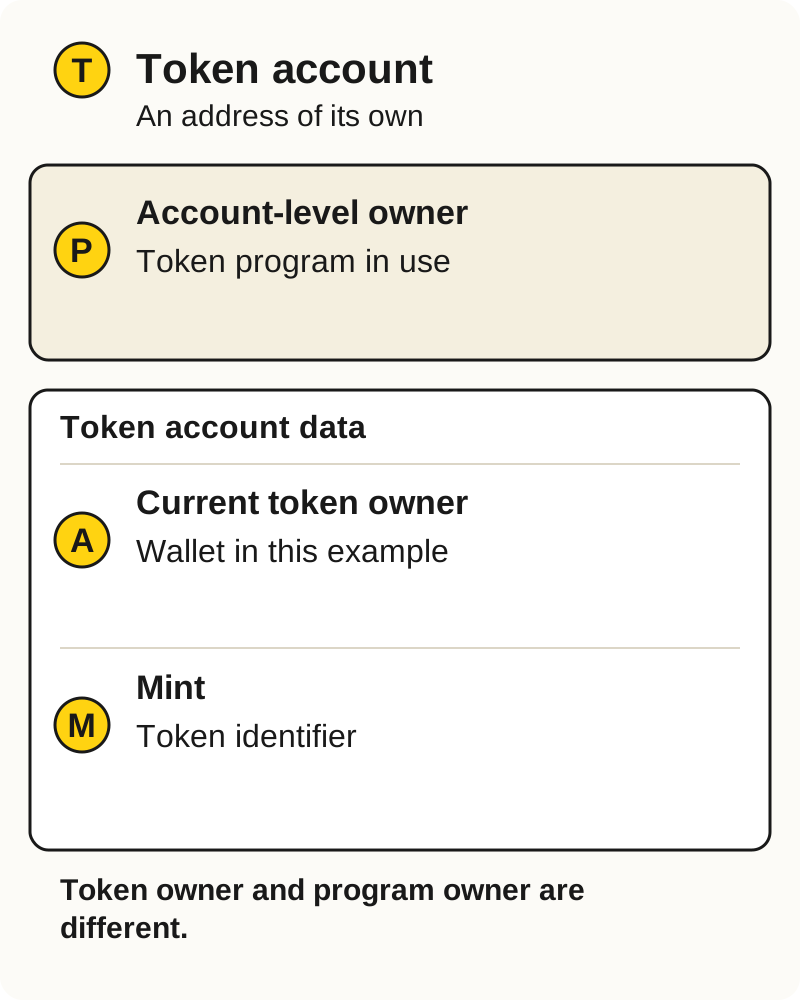
Reading P as your wallet address mixes up two different meanings of owner. Reading M as your wallet address instead selects the asset identifier. Neither establishes the authority whose holdings you meant to inspect.
An ATA is the default account, not the whole inventory
An associated token account, or ATA, is the standard token account for a wallet, token program and mint. Those inputs determine its address. The resulting account belongs to its token program; the Associated Token Program is not its program owner.
The token overview also notes that an authority can have multiple token accounts for one mint. Finding the ATA alone therefore does not establish that you found every account. Read the current recorded authority rather than inferring it solely from an address derivation or an old transaction.
For a broader inventory, getTokenAccountsByOwner returns accounts for an authority with a mint or program filter. A program-specific filter limits that query to the selected program. This is a way to inspect the scope of a result, not a promise that a single query covers every Solana position.
Make one identification record
- Fix the context. Note the cluster and the complete public address of the authority you intend to inspect. For a particular asset, keep its intended mint from the issuer’s official reference separately.
- Inspect the exact account. Use a trusted explorer or read-only account reader. Check whether the decoded record is a token account or a mint. If its type is unavailable, leave the classification unresolved. If it is a mint, record its address as M and its type as mint. The next two steps apply to token accounts.
- Match its fields. For a token account, compare the current token-owner authority and mint with your intended values. Record the governing program separately. Compare full addresses, not shortened labels.
- Retain the observation. Keep the cluster, decoded type, T, A, M, P, the reported amount and the response slot or observation time. Mark the result identified, mismatched or unresolved. A mismatch means the record does not match your chosen authority or asset; it does not explain why.
A missing account and a failed reader are different results. The getAccountInfo reference specifies that result.value is null when the account does not exist at the requested commitment. That says nothing by itself about other accounts belonging to the authority. An error or unreadable response leaves this check unresolved.
When adding an address to Owlio, use the public address of the wallet account you intended to track. Its address-format check does not establish whether the input is a wallet authority, mint or token account, or guarantee complete holdings. Keep the field record from this check. If the identities match but the displayed portfolio still differs, continue with the portfolio balance mismatch guide to examine coverage and data freshness.
Frequently asked questions
Does a mint address show my personal token balance?
The mint identifies the token and stores shared data such as its supply. Your holding is recorded in token accounts associated with a token-owner authority. A mint's supply is not the amount held by that authority.
Does knowing an ATA address prove the account exists?
No. An ATA address can be derived from the wallet address, token program and mint before the account exists. Inspect its current account data on the intended cluster. A missing ATA also does not rule out other token accounts for the same authority and mint.
Does the recorded token owner prove who controls the funds?
It names an onchain authority, not a person's identity or proof that you control that authority. Delegates and token extensions can affect permissions. Identifying the account is not a complete check of transfer permissions or spendability.