 Owlio
WBTC vs Bitcoin: separate your token balance from BTC reserves
WBTC in an Ethereum account and BTC in a custodian's reserve are different records. Find your holding without counting its backing as another asset.
WBTC in an Ethereum account is a token holding, not native BTC at a Bitcoin address. WBTC describes its tokens as backed by BTC held in custody. That backing does not give your Ethereum account a second Bitcoin balance or the keys to a reserve address.
To understand a portfolio entry, separate three questions: what your account holds, what backs the token, and how a service would convert it. This guide shows how to identify the holding and interpret published reserve information without connecting a wallet or signing anything. Ethereum Mainnet is the WBTC example; other deployments need their own references.
A WBTC balance is not a Bitcoin output
On Bitcoin, a wallet’s BTC amount comes from unspent transaction outputs, usually shortened to UTXOs. The Bitcoin transaction guide explains how these outputs hold amounts that later transactions can spend.
Ethereum WBTC uses a different record: a token contract tracks balances for Ethereum accounts. The ERC-20 interface calls that account-level read balanceOf. A positive result there does not identify a Bitcoin output controlled by the same person.
| Record | What it describes |
|---|---|
| BTC in your Bitcoin wallet | Bitcoin outputs within that wallet’s scope |
| WBTC in your Ethereum account | Units recorded by the WBTC token contract |
| BTC on the WBTC reserve dashboard | The project’s reported custodian reserves |
If your question is about pending native Bitcoin rather than WBTC, use the confirmed and pending BTC guide. Its address and transaction checks do not turn an Ethereum token into a Bitcoin holding.
Identify the Ethereum token you actually hold
Start from the Ethereum account containing the token, then open its token details in an Ethereum explorer. The WBTC transparency page links this Ethereum Mainnet token contract:
0x2260fac5e5542a773aa44fbcfedf7c193bc2c599
Compare the complete address. This is the token’s identifier, not your receiving address or an instruction to send funds. If the two address roles are unclear, the account versus token contract guide explains them.
A practical record needs four things:
- Account and network. Keep the full Ethereum account address alongside Ethereum Mainnet.
- Token identity. Match the holding’s contract with the official Ethereum entry. A symbol or Bitcoin logo cannot establish that match.
- Account amount. Record the WBTC quantity for that account, not the contract’s total supply or the reserve total. If you read a raw integer, establish its decimal scale before comparing it with a formatted amount.
- Observation. Save the block or observation time. Keep an unavailable lookup marked unavailable, rather than writing zero.
A different contract remains unidentified until you establish what it represents. It may be another deployment, another token or an imitation. This Ethereum address does not classify every asset using a BTC-related name.
There is a naming trap in the issuer’s own documentation: its deployment reference distinguishes native WBTC from bridged WBTC. Here, native describes WBTC issuance on a supported chain. Native WBTC on Ethereum is still an Ethereum token, not Bitcoin’s native BTC.
What the reserve dashboard can tell you
WBTC’s backing description links issued tokens to Bitcoin held by custodians. Its transparency page lists reserve addresses and separates reserve BTC from circulating WBTC. Those are system-level observations; they are not a list of extra Bitcoin balances belonging to each token holder.
For a hypothetical example, suppose your Ethereum account contains 0.05 WBTC. The backing model does not give you another 0.05 BTC to add as a separate asset you control. You have the token holding; the reserve supports that holding. The example assigns no particular Bitcoin output or reserve address to you.
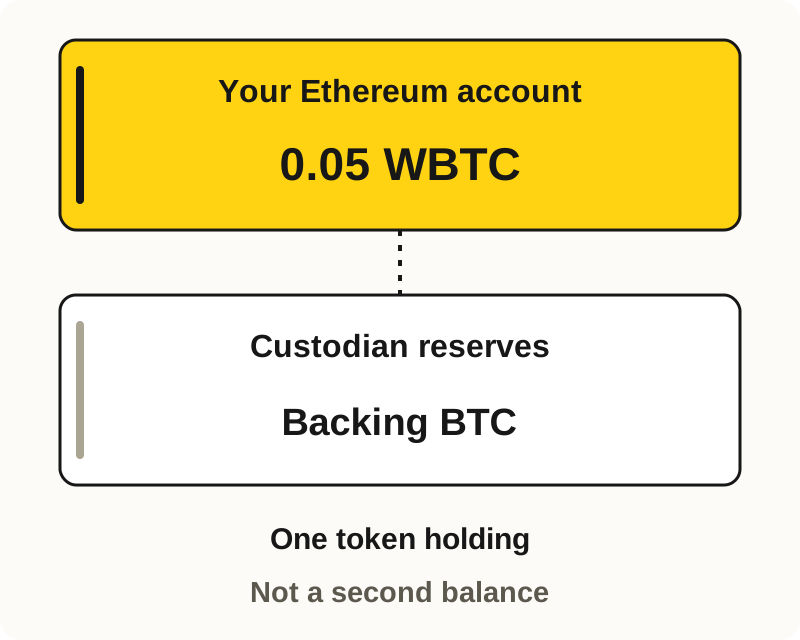
Record the dashboard’s timestamp if you inspect its figures. A published reserve balance does not prove that you control those BTC or can redeem immediately. Reading it is not an independent audit of the custody arrangement. This article has not audited reserves or tested a wallet balance.
Redemption is a separate process
The WBTC FAQ describes conversion through supported services and direct redemption through authorized merchants. Its redemption mechanism involves burning WBTC and releasing BTC through the custody process.
An ordinary ERC-20 transfer only moves the token between Ethereum accounts. It does not itself carry out that redemption. Do not send WBTC to the token contract or treat a Bitcoin receiving address as an Ethereum transfer destination.
This also differs from the same-chain mechanism in the ETH and WETH guide. A familiar word such as “unwrap” does not establish that the same steps, permissions or conditions apply to WBTC.
If you later consider conversion, verify the service’s current source contract and network, native-BTC destination support, eligibility, quote, fees and timing. The project’s 1:1 backing description supplies none of those personal transaction terms. No conversion is needed merely to identify your holding.
Why Owlio’s BTC row can include WBTC
The source code associated with Owlio 1.1.0, checked on 8 November 2026, allows the BTC row to combine native BTC and recognized Ethereum WBTC. Expand it to inspect the network, wallet entry and WBTC label. The recognized token’s full contract is not shown in that breakdown; verify it separately using the official reference and explorer.
Keep those underlying holdings distinct in your notes even when they share a headline total. A portfolio row is not proof of address control, reserve sufficiency or redemption eligibility. The useful result is an identified account holding, with any reserve observation and conversion conditions recorded separately.
Frequently asked questions
Does native WBTC mean native Bitcoin?
No. In WBTC's deployment terminology, native can describe how WBTC is issued on a supported chain. WBTC on Ethereum is still an ERC-20 token, not BTC recorded on the Bitcoin network.
Can I send Ethereum WBTC directly to a Bitcoin receiving address?
An Ethereum WBTC transfer does not deliver native Bitcoin. A separate conversion or redemption service would need to support the exact source token and network, and native BTC as the destination. Do not use a Bitcoin address as a substitute for that process.
Does 1:1 backing guarantee the price or timing of my conversion?
No. The project's backing description does not establish the quote, fees, eligibility or completion time available to you from a particular service. Those conditions require a separate current check.