 Owlio
zkSync Lite is shut down: how to check for and withdraw leftover funds
zkSync Lite no longer produces blocks, but the balances left on its addresses have not gone anywhere. Here is how to find them, how to withdraw them to Ethereum, and where it is easy to go wrong.
- What exactly stopped on 4 May 2026, and whether withdrawals have a deadline
- Three ways to check an address without connecting a wallet
- A step-by-step withdrawal through lite.zksync.io, plus a fallback that skips the portal
- How to keep your leftover funds away from phishing sites
Time to apply: 10-15 minutes per address
What happened to zkSync Lite, and how long do you have to withdraw?
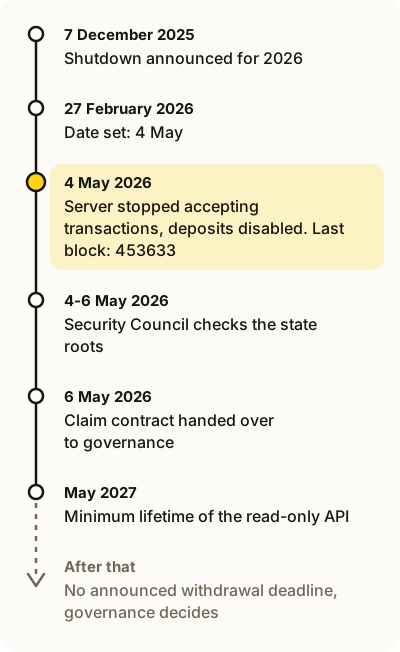
zkSync Lite stopped producing blocks on the morning of 4 May 2026 (UTC), and deposits from Ethereum have been switched off. Balances left on addresses have not disappeared: you can retrieve them through the claim contract on Ethereum, and the official portal for that is lite.zksync.io. Matter Labs did not announce a withdrawal deadline in its blog post on the shutdown. The read-only API with the network’s final state is promised for at least a year, which means until May 2027 at the earliest.
zkSync Lite is Matter Labs’ first zk-rollup, launched in 2020. A zk-rollup is an L2 that bundles transactions into batches and posts a cryptographic proof to Ethereum that each batch was computed correctly. The ZKsync team first announced the shutdown in December 2025 and set the 4 May date at the end of February 2026. At that point, by The Block’s count, about $33.9 million was still sitting in Lite, $24.9 million of it in stablecoins.
The network’s last block is 453633, finalized on 4 May 2026 at 11:14 UTC. You can see this in the read-only API, which still answers requests. On 6 May, control of the claim contract passed to ZKsync governance, and further decisions about the withdrawal mechanism are made by the Token Assembly. For the time being, until the security review is complete, Matter Labs has kept the right to pause withdrawals.
Why might you have funds left on zkSync Lite?
If you were farming the ZK airdrop, you may well have a balance left in Lite. One of the airdrop criteria was activity on Lite in more than three different months before zkSync Era launched, and people moved small amounts there to qualify. Another route into Lite was donating through Gitcoin Grants, whose rounds ran on this network.
The ZK airdrop went out starting 17 June 2024, based on a snapshot from 24 March 2024. ZK Nation’s criteria had two items for Lite, worth one point each: activity in more than three different months before the Era mainnet, and donations to Gitcoin through rounds on Lite. Those points were only enough when combined with bridging to Era, so Lite was a stopover on the way to the airdrop, and it is easy to forget what was left there.
ZKsync says the network served more than 3.5 million addresses in its lifetime. Even people who have not given Lite a thought in years can have balances there. In the network’s final state, the public address vitalik.eth holds, among other things, 14.52 USDC, 1.88 DAI and 0.0155 ETH (checked through the read-only API on 25 September 2026). The amounts are small, but across ten or so wallets left over from the airdrop they add up.
How do you check for leftover funds on zkSync Lite?
You can check an address without connecting a wallet or signing anything: just enter the address in a public service that reads the network’s final state. Three options work: the lite.zksync.io withdrawal portal, the zkscan.io block explorer, and the Owlio extension if your wallets are already in it. All of them need only the address, not a seed phrase or a private key.
| Method | What you enter | What you get | Limitation |
|---|---|---|---|
| lite.zksync.io | An address or a connected wallet | Token balances and a withdraw button | One address at a time |
| zkscan.io | An address | Balance and transaction history on Lite | No withdrawals, view only |
| Owlio, “Forgotten assets” section | Nothing: it takes the addresses from your portfolio | A report on all EVM wallets at once | Shows the balance, not whether it was withdrawn |
All three read the state as it was frozen at the shutdown. If you have already withdrawn your funds through the claim contract, zkscan.io and Owlio will still show the old balance: in Lite’s final state, it stays that way forever. Only the withdrawal portal or your own wallet on Ethereum can tell you whether you withdrew.
Owlio is a free Chrome extension that tracks your portfolio from your wallet addresses, with no account and no server. For checking Lite, it is handy when you have many wallets: one click runs through every EVM address in your portfolio. How that works is covered in the Owlio section below.
How do you withdraw from zkSync Lite through lite.zksync.io?
All the tokens found on your address are withdrawn in one go through the official portal, lite.zksync.io: it finds your address in the network’s final state, builds a proof and submits a claim to the contract on Ethereum. The tokens arrive at the same address, only on Ethereum this time. The ZKsync team pays the gas for the first 100,000 withdrawals, so you may not need any ETH for fees.
- Type
lite.zksync.ioby hand or open it from the official ZKsync blog. Do not follow links from direct messages or ads. - Enter your wallet address in the lookup field or connect your wallet. The portal will show the balance of each token, or a message saying there is nothing for that address.
- Connect the wallet that owns the address. Without that, you cannot withdraw: the portal’s interface only lets the owner’s wallet withdraw.
- Press the withdraw button. The portal withdraws all the tokens it found at once.
- Confirm the request in your wallet. While gas is sponsored, your wallet asks you to sign a
ClaimBatchmessage with your address as the recipient, and the portal sends the Ethereum transaction. Without a sponsor, your wallet will prompt you to send the transaction to the claim contract yourself. Neither version should include a spending approval for your tokens (approve,permit). - Wait for the confirmation and open the transaction link. The tokens will appear at your address on Ethereum.
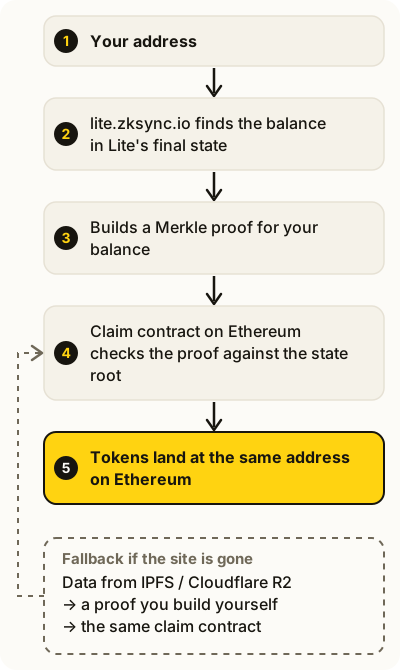
You cannot change the recipient address. According to the contract description on the ZK Nation forum, funds always go to the address recorded in Lite’s final state, even if someone else sent the transaction. So only the owner of the address gets the money, and on the portal you can withdraw only after connecting the owner’s wallet.
What if the portal is down or you do not trust the site?
The portal is not the only way out: Matter Labs has published the network’s final state and tools for withdrawing on your own. Data on accounts, balances and tokens is stored on IPFS and Cloudflare R2, and the code that builds the tree is in the matter-labs/zksync repository. With these, you can build a proof and submit a claim to the contract directly, without any ZKsync website.
A manual claim needs your Lite account ID, the token ID, the amount and a Merkle proof against the published root. To make withdrawals to Ethereum cheaper, a second tree recomputed with Keccak has been published alongside the original one built on the Poseidon hash. This route is meant for people who can work with contracts directly; for everyone else, it is simpler to wait until the portal is back up.
The claim contract’s address on Ethereum is 0x0a14B696350546110a0D8acDb86226983af9D2a0, as published in the announcement on the ZK Nation forum. If your wallet shows a contract address in the request, compare it with this one: that makes a fake site easier to spot.
What happens to funds nobody withdraws?
Officially, balances in Lite’s final state still belong to their owners, and there is no announced deadline for withdrawing them. But decisions about the withdrawal mechanism and the fate of unclaimed balances now rest with ZKsync governance, and a new decision could change the rules. It is safer to withdraw now, while the portal, sponsored gas and the read-only API are all still running.
In its shutdown blog post, Matter Labs says it accounted for even the smallest balances. The same post says that keeping Lite online indefinitely costs too much for the value it provides. The read-only API for the final state is promised for at least a year after 4 May 2026, and that is the only time frame in the official documents.
How do you avoid phishing when withdrawing from zkSync Lite?
The main rule: neither the withdrawal portal nor a portfolio tracker ever asks for your seed phrase. Check the site’s address letter by letter (lite.zksync.io) and sign transactions only in your own wallet. A page that asks for your seed phrase or private key “to recover funds” is stealing them.
An old network shutting down is a convenient pretext for scammers. The usual tricks look like this:
- An email or message saying “you have N ETH left on zkSync Lite, claim it by the end of the week”. There is no official deadline, so the urgency is a sign of a scam.
- A site with a lookalike address: an extra letter, a different top-level domain, “zksync-lite-claim” in the name.
- A request to sign
approveorpermitfor your tokens on Ethereum. Withdrawing from Lite takes aClaimBatchsignature or a call to the claim contract; no spending approval is needed. - “Support” on Telegram or Discord that messages you first and offers to help with the withdrawal.
If in doubt, open the ZKsync blog and follow the link to the portal from there. It takes a minute longer and protects you from all four tricks at once.
How does Owlio search for forgotten assets on frozen networks?
Starting with version 1.1.0, Owlio has a “Forgotten assets” section: a one-time check of networks that have stopped producing blocks and that portfolio trackers no longer show. Right now the list has one such network, zkSync Lite. The check runs on the addresses in your portfolio, without connecting a wallet and without an Owlio server.
The section is in the extension’s Settings. Above the “Search for forgotten assets” button, Owlio tells you in advance who will see your addresses: for zkSync Lite, that is api.zksync.io, the network’s public API. The requests go straight from your browser and do not reach an Owlio server, because Owlio has no server.
What happens when you press the button:
- Owlio checks each EVM wallet in your portfolio in turn and shows a counter: “Searching: N of M checked”. You can stop the search, and anything found by then stays on screen.
- Each wallet gets a line: the tokens found and their amounts, “Nothing here”, or an honest “No answer - not checked”. Owlio does not pass off an unchecked address as empty.
- If anything turns up, a link appears under the report: “How to withdraw from zkSync Lite - official page”. It is hard-coded into the extension and leads to
https://lite.zksync.io/; it is not taken from the network’s response.
Whatever it finds is not counted in your portfolio total: these funds can only be withdrawn through the network’s own exit procedure, and no price is shown next to them. The report is not saved, and searching again takes one click. Owlio reads the frozen state, so a balance you have already withdrawn will be shown as found. You can check whether you withdrew it on the withdrawal portal.
If you have several addresses from those days, the simplest approach is to check them all at once and then withdraw through the official portal one by one. You can install Owlio from the Chrome Web Store, and what it does with your addresses is described on the Owlio home page and in the privacy policy.
Frequently asked questions
Is there a deadline to withdraw from zkSync Lite?
No deadline has been announced. Balances in the network's final state can be retrieved through the claim contract on Ethereum, but future withdrawal rules are up to ZKsync governance. The read-only API with the final state is promised for at least a year after 4 May 2026.
Do you have to pay gas to withdraw from zkSync Lite?
ZKsync pays for the first 100,000 withdrawals made through the lite.zksync.io portal. Once that limit runs out, you will most likely have to pay for the Ethereum transaction yourself, so it does not hurt to keep a little ETH on the address.
Can you withdraw from zkSync Lite to a different address?
No. Tokens go to the address recorded in zkSync Lite's final state, even if someone else sent the transaction. On the lite.zksync.io portal, you can withdraw only after connecting the wallet that owns that address.
Does the zkSync Lite shutdown affect zkSync Era or the ZK token?
No. In its announcement, the ZKsync team wrote that the shutdown does not affect other ZKsync systems. zkSync Era is a separate network with its own contracts.
Owlio shows a zkSync Lite balance, but I have already withdrawn everything. Is that a bug?
No. Like the block explorer, Owlio reads zkSync Lite's frozen state as of the moment the network stopped, and in that state the balance stays forever. The record of your withdrawal is kept in the claim contract on Ethereum, and the lite.zksync.io withdrawal portal shows it.