 Owlio
Why unstaked SOL can still be in a Solana stake account
Inactive stake is not a wallet payment. Check where the SOL is held, who can authorize a withdrawal and whether a transfer actually happened.
A Solana stake account holds SOL separately from your wallet account. Unstaking changes its delegation state; it does not automatically send that SOL back to the wallet. An Inactive label can therefore coexist with a stake-account balance and an unchanged wallet balance.
This guide helps explain that gap using public records. It covers an existing native stake account, not a liquid-staking token or a custodial staking claim. The inspection is based on documentation checked on 11 November 2026; no live staking transaction was performed for it.
Read the account total before its staking labels
Start with the exact stake-account address shown in your original staking records or wallet’s native-staking details. Open that address in a public explorer or read-only account reader on the intended Solana network (cluster). A wallet address, stake-account address and validator address identify different records.
The Solscan stake-page guide distinguishes these amounts. Other readers may use different labels:
| Displayed field | How to treat it in the comparison |
|---|---|
| SOL Balance | Total SOL held at this stake-account address |
| Delegated Stake or Active Stake | Staking amounts within the account, not extra holdings |
| Total Reward | Cumulative reward history, not a second current balance |
Keep the wallet account’s SOL balance on a separate line. Solana’s getBalance reference describes a balance for one specified address; that number alone is not an inventory of every stake account associated with a wallet.
For an invented example, suppose the wallet account holds 2 SOL and one identified stake account holds 10 SOL at the same observation time. Those two accounts hold 12 SOL in total. Adding the stake account’s active or delegated amount again would count part of the 10 SOL twice. This example says nothing about how much can be withdrawn.
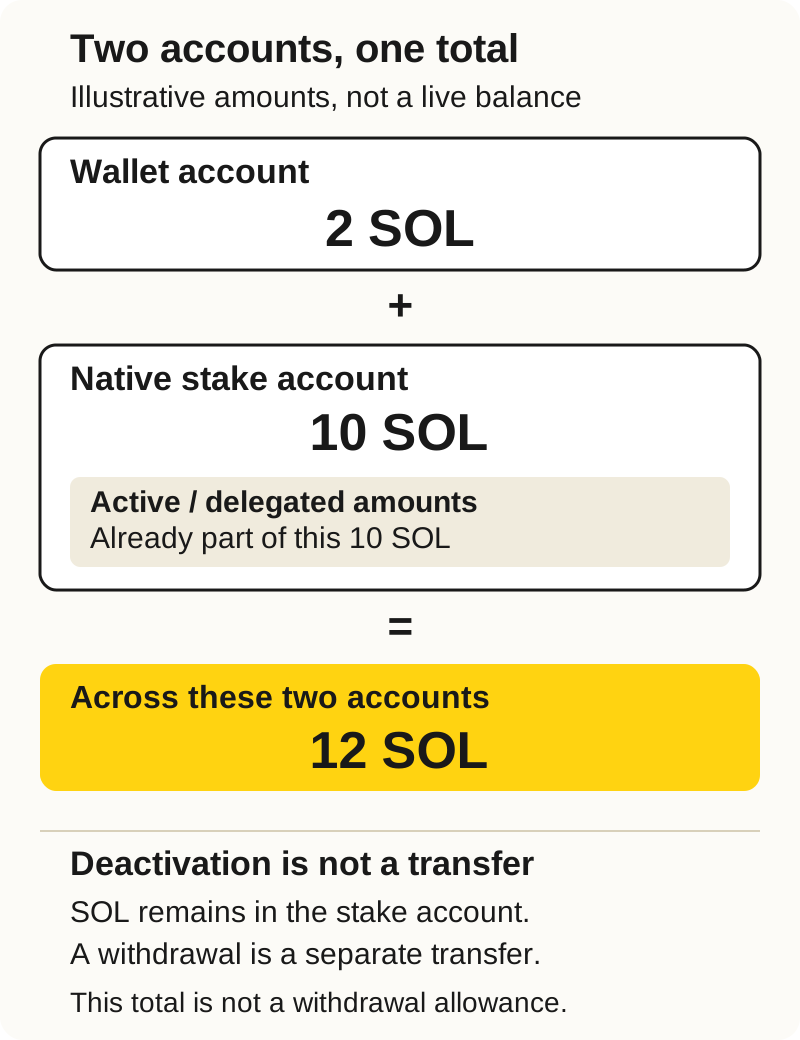
A stake account also needs a storage reserve. The account documentation explains the minimum balance needed for account storage. Do not calculate spendable SOL by simply subtracting an Active Stake field from the total: delegation, reserve and withdrawal rules require their own checks.
Unstaking changes the state; withdrawal moves the SOL
Phantom’s native-staking guide explicitly separates unstaking from the later withdrawal. Its troubleshooting section addresses the case where a user has unstaked but the SOL is still absent from the wallet.
Read the current state instead of treating the date you pressed Unstake as proof of payment. Deactivating means the transition is still in progress. Inactive describes the stake’s state; it does not show that a transfer to your wallet has occurred. Completion depends on the applicable epoch and account conditions, so a generic countdown cannot prove that this account has completed the transition.
If a withdrawal is claimed to have happened, inspect that transaction’s result, source stake account, recipient and amount. Then check the recipient’s current balance and any later movements. A past transfer and today’s balance answer different questions. If the transaction record or current account state is unavailable, keep the result unresolved.
Rewards also need the right location: Phantom describes native staking rewards as SOL paid into the stake account. A reward history helps explain changes there; adding the full reward history to its current balance would count past credits again.
Check who can authorize withdrawal and where it went
The Solana stake-account reference names two roles. The stake authority can manage delegation and deactivate stake. The withdraw authority authorizes withdrawals. They may be the same address or different addresses.
The withdraw authority is not a fixed payout destination. In Anza’s withdrawal documentation, the authorizing key and recipient address are separate inputs. Match an actual recipient from the withdrawal record; do not assume SOL must have arrived at the authority’s own address.
Also read any lockup information exposed by the account reader. A lockup can restrict withdrawal even when a simple staking label looks ready. Anza notes that the permitted amount depends on the current staking state and lockup. Conversely, calling an account Active does not prove every lamport in it is delegated or unavailable. None of these labels is a complete withdrawal quote.
These are checks of recorded roles and conditions. Seeing your familiar address in a field does not prove control of its signing key, and the address that originally funded the stake account is not a substitute for its current authorities.
Keep a note that explains the wallet gap
Use one row per stake account, rather than one row per balance label:
- Identify the record. Save the cluster and full stake-account address. Confirm that the decoded record is a native stake account. If it is a token account or mint, use the separate Solana token-account identification guide.
- Record the current snapshot. Keep its total SOL, staking state, staking amounts, both authorities, any visible lockup and the observation time. On a separate line, record the wallet account’s full address, SOL balance and observation time. Mark unavailable fields unknown instead of assuming zero or no restriction.
- Check the alleged payment. If you expect a completed withdrawal, retain its transaction reference, result, recipient and amount. Compare that recipient with the wallet account whose balance you are checking. An unstake action alone is insufficient.
- Classify the difference. State whether the SOL remains in the stake account, a completed withdrawal has been identified, or the evidence is incomplete. Count each current account balance once. Finding one stake account does not establish a complete inventory.
Owlio 1.1.0, publicly listed when checked on 11 November 2026, reads SOL at the added Solana address and its token holdings. It does not automatically discover separate native stake accounts through that wallet’s stake or withdraw authority. Keep the stake-account note alongside the tracker; the broader balance-mismatch guide covers other data and coverage gaps.
No wallet connection or signature is needed for this public-record inspection. Its result explains the records behind the difference; it does not execute a withdrawal or establish that the displayed total is immediately spendable.
Frequently asked questions
Do native staking rewards arrive directly in my wallet balance?
They are paid into the native stake account in SOL. A cumulative rewards figure describes history; it is not another current holding to add to that account's balance. A later withdrawal is a separate movement.
Can several stake accounts use the same wallet authority?
Yes. The same stake and withdraw authorities can be assigned to multiple stake accounts. Finding one account does not prove that you found the complete inventory. Record each distinct stake-account address once.
Does an Inactive label guarantee I can withdraw the whole balance?
No. Check the current account, withdraw authority and any lockup. The amount permitted for a withdrawal depends on the account's actual state and rules. A displayed status is neither an executed transaction nor a quote for how much you can withdraw.