 Owlio
USDC vs USDC.e: Check the Token in Your Wallet
A single portfolio row can combine native and bridged USDC. Separate the holdings by their network and full token contract address.
USDC and USDC.e can have different contracts on the same network. To identify a holding, check its network and full token contract address against an official reference for that chain. You can do this with your public wallet address; the check requires no wallet connection or transaction signature.
The example below uses Arbitrum One. Sources and Owlio’s publicly listed version 1.1.0 were checked on 5 October 2026. Use the current official references again when checking another network or a later product version.
What is the difference between USDC and USDC.e?
Native USDC is issued by Circle directly on a supported network. Bridged USDC represents USDC moved through a bridge from another chain. On Arbitrum One, the Ethereum-bridged form is called USDC.e. Its bridge locks USDC on Ethereum and creates a representation on Arbitrum.
Circle explains the native and bridged distinction, including the extra dependence on the bridge. The names used for bridged tokens vary: a wallet might show USDC.e, Bridged USDC or a bridge-specific label. The ticker and logo alone cannot identify a token.
| Check | Native USDC | A bridged USDC representation |
|---|---|---|
| Origin | Issued by Circle on that network | Created through a bridge from another network |
| Reference for identity | Circle’s contract list for the chain | The chain or bridge’s official reference |
| Bridge dependence | No lock-and-mint bridge for its native issuance | Depends on the particular bridge mechanism |
A dollar value in a portfolio does not establish either the contract’s identity or the rate available for a swap. Identification and valuation are separate checks.
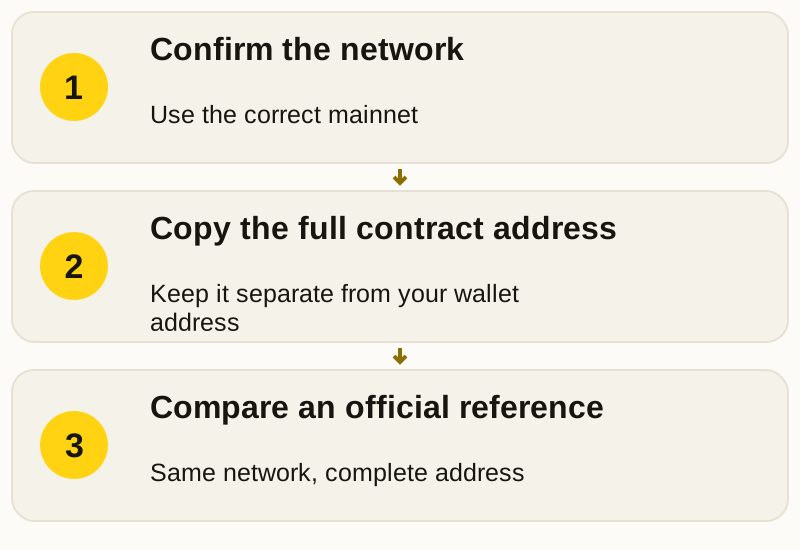
Identify the holding without connecting your wallet
Find the network and token contract address for one holding. Your wallet address tells the explorer which account to inspect; the token contract tells you which asset that account holds. Keep those two addresses separate.
- Confirm the network. Record the chain where the balance appears. Use the mainnet reference for real holdings; a testnet token is a different record. For Arbitrum, distinguish Arbitrum One from Nova and Sepolia.
- Open that network’s explorer. Follow an explorer link from the network’s official documentation and search for your public wallet address. Arbitrum’s network reference lists Arbiscan for Arbitrum One.
- Open the token details. Locate the holding in the account’s token list and copy its complete contract address. Etherscan’s field guide distinguishes Contract Address from Quantity; other explorers may use different labels. A shortened address is not enough for this comparison.
- Compare the contract with a reference for the same chain. Start with the Mainnet section of Circle’s official USDC contracts. An exact address match on that chain identifies native USDC. For a bridged form, find the chain or bridge’s own documentation and compare its full address too.
If the address does not match Circle’s list, leave its identity unresolved until you find another authoritative reference. A different contract can be a bridged token, a different asset or an imitation. A different contract is not enough to identify the token as USDC.e.
Record the network and full token contract address, then note the confirmed token representation or mark it as unknown. If a page asks for a seed phrase, private key or signature just to inspect a public balance, stop. Those inputs are unnecessary for this read-only procedure.
Worked example: two contracts on Arbitrum One
Arbitrum One is the mainnet with chain ID 42161. Arbitrum documents two USDC forms on that network; Circle’s Mainnet list confirms the native contract.
| Token on Arbitrum One | Complete token contract |
|---|---|
| Native USDC | 0xaf88d065e77c8cC2239327C5EDb3A432268e5831 |
| Ethereum-bridged USDC.e | 0xff970a61a04b1ca14834a43f5de4533ebddb5cc8 |
Compare your holding’s contract with the entire relevant address. These are token contracts, not your wallet’s receiving address. The example identifies these two contracts only; it does not classify a third contract that happens to use the name USDC.
Use the reference for a different network when checking a holding there. Native USDC on Ethereum, Base or another supported chain has its own entry in Circle’s list. The Arbitrum example is not a universal address list.
What a combined Owlio balance tells you
Owlio 1.1.0 groups recognized native and bridged USDC forms under one asset. When you open a position, the breakdown can show networks, shortened wallet addresses and form labels. It does not show the complete token contract address needed for the identity check above.
That makes the tracker useful for finding where to look. Add your public addresses in Owlio, find the network holding the asset, then verify the specific contract in that chain’s explorer. A combined USDC quantity cannot by itself establish that every part is native USDC or accepted by the same destination.
Owlio’s Chrome extension displays holdings and cannot convert these tokens. Its public data providers can see requested wallet addresses and your IP address; the privacy policy describes that data flow. If an amount or price is missing, use the separate portfolio balance checklist to diagnose that gap.
Check destination support separately
Knowing which token you hold does not tell you whether a particular exchange, app or bridge accepts it. A destination’s USDC label may omit the representation; check its current instructions for the exact network and token variant. If the accepted contract is unclear, ask the service to confirm it before sending.
Native USDC becoming available on a chain also does not automatically migrate the older bridged token. The current Arbitrum documentation still distinguishes both contracts. Conversion would be a separate operation with its own support, fees and risks; there is no universal route promised here.
Keep the network and full contract address in your notes before interpreting a combined portfolio balance or planning a transfer. If the remaining problem is an unsolicited token with a familiar-looking name, the spam token and NFT guide covers that case.
Frequently asked questions
Does USDC.e automatically become native USDC?
When native USDC becomes available on a network, an existing USDC.e holding does not automatically convert to it. On Arbitrum One, the two forms have separate contracts. Check any proposed migration against the network or bridge's current official documentation.
Can Owlio convert USDC.e to USDC?
Owlio 1.1.0 is a read-only portfolio tracker. It can display recognized token holdings, but it does not swap or move them. Token conversion depends on another service's actual support and conditions. This guide covers identification only.
Does a matching contract mean a transfer will be accepted?
A contract match identifies the token on that network. It does not establish that an exchange or another recipient accepts it. Check the destination's current rules for the exact network and token representation before sending.